
Hardware zusammenbau und Testen
Beschreibung:
Zusammenbau am Steckbrett und Testsoftware.
### *** DISPLAY PINS sind intern verbunden, werden hier nur für die Programmierung aufgelistet :**
```
TFT_SCLK  39
TFT_MOSI  38
TFT_MISO  40
TFT_DC    42
TFT_CS    45
TFT_RST   -1
TFT_BL    1
```
Buttons:
UP:     GPIO 2  → GND (mit Pullup)
DOWN:   GPIO 3  → GND
LEFT:   GPIO 4  → GND
RIGHT:  GPIO 5  → GND
A:      GPIO 6  → GND
B:      GPIO 7  → GND
START:  GPIO 8  → GND
SELECT: GPIO 9  → GND
```

### **Potis (10kΩ):**
```
POT_VOLUME: GPIO 10 (Mittelpin), GND + 3.3V
POT_BRIGHT: GPIO 11 (Mittelpin), GND + 3.3V
```

### **MAX98357A Audio:**
```
BCLK: GPIO 12
LRC:  GPIO 13
DIN:  GPIO 14
VIN:  5V oder 3.3V
GND:  GND
```

### **PN532 NFC:**
```
SDA: GPIO 48 (shared mit Touch)
SCL: GPIO 47 (shared mit Touch)
```

### **SD Card:**
```
CS: GPIO 15 (nutzt SPI vom Display)
IDE installieren
Nachdem die IDE installiert müssen wir unser Board auswählen und ein paar Pakete installieren.
Ert board auswählen

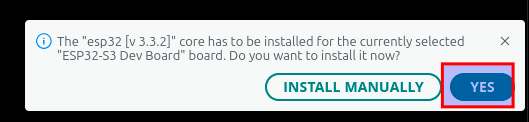
Dann werden wir gefragt ob wir das Paket für ESP32 installieren wollen, da klciken wir auf yes
Dazu klicken wir auf das Library Manager Symbol
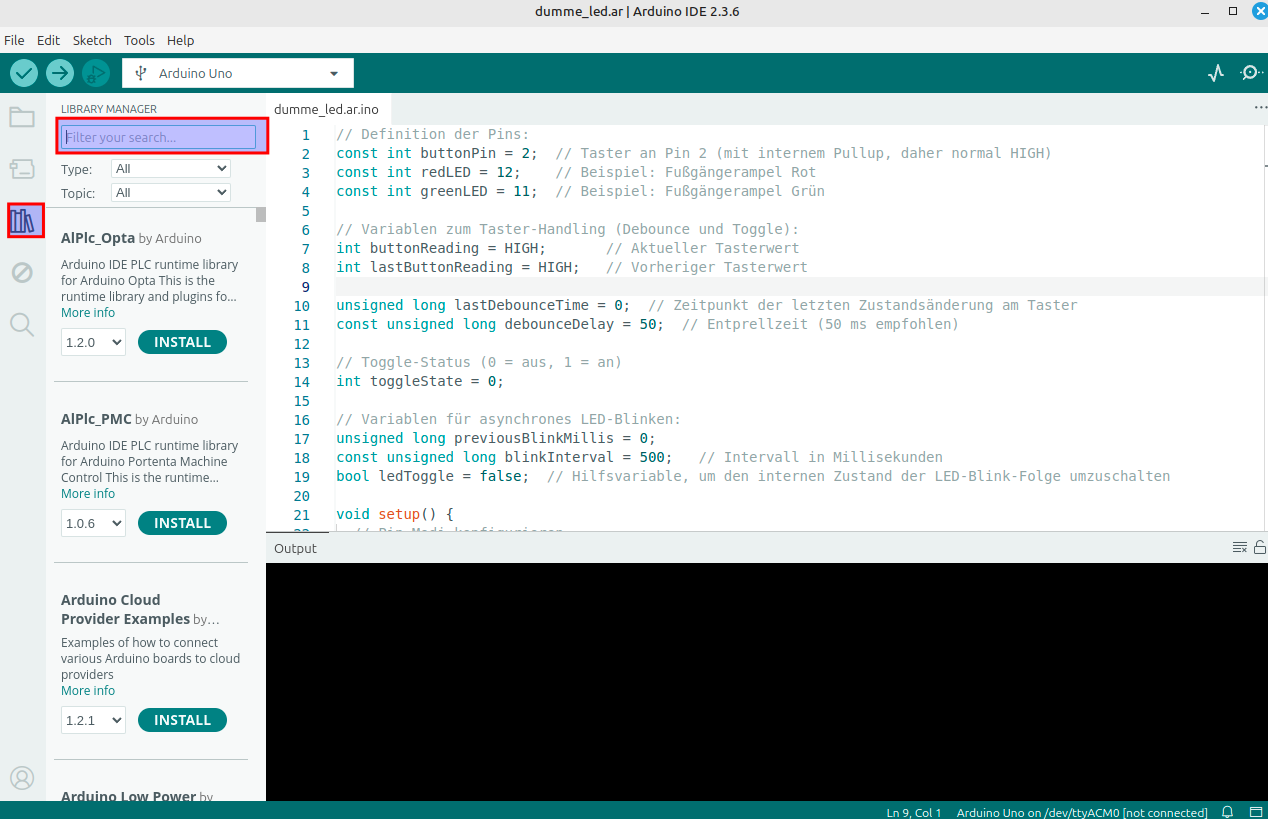
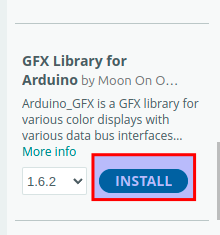
Geben als Suchbegriff folgende namen ein und installieren diese.
Hintereinander eingeben, natürlich
| Library Name | Suchbegriff | Bild |
| GFX Library for Arduino | *arduino*gfx* |
|
Nun das Testprogramm einfügen
Testprogramm
#include <Arduino.h>
#include <Arduino_GFX_Library.h>
#include <Wire.h>
#include <SD.h>
#include <SPI.h>
#include <driver/i2s.h>

// ===== DISPLAY PINS =====
#define TFT_SCLK  39
#define TFT_MOSI  38
#define TFT_MISO  40
#define TFT_DC    42
#define TFT_CS    45
#define TFT_RST   -1
#define TFT_BL    1

// ===== BUTTON PINS (mit INPUT_PULLUP) =====
#define BTN_UP      2
#define BTN_DOWN    3
#define BTN_LEFT    4
#define BTN_RIGHT   5
#define BTN_A       6
#define BTN_B       7
#define BTN_START   8
#define BTN_SELECT  9

// ===== POTENTIOMETER (ADC) =====
#define POT_VOLUME  10  // ADC für Lautstärke
#define POT_BRIGHT  11  // ADC für Helligkeit

// ===== I2S AUDIO (MAX98357A) =====
#define I2S_BCLK    12
#define I2S_LRC     13
#define I2S_DOUT    14
#define I2S_NUM     I2S_NUM_0

// ===== NFC (PN532 auf Touch-I2C) =====
#define NFC_SDA     48
#define NFC_SCL     47
#define PN532_I2C_ADDRESS 0x24

// ===== SD CARD =====
#define SD_CS       15

// ===== DISPLAY =====
#define SCREEN_WIDTH  240
#define SCREEN_HEIGHT 320

Arduino_DataBus *bus = new Arduino_ESP32SPI(TFT_DC, TFT_CS, TFT_SCLK, TFT_MOSI, TFT_MISO);
Arduino_GFX *gfx = new Arduino_ST7789(bus, TFT_RST, 0, true, SCREEN_WIDTH, SCREEN_HEIGHT);

// ===== GLOBALE VARIABLEN =====
int volumePercent = 50;
int brightnessPercent = 80;
String nfcUID = "Waiting...";
bool sdCardOK = false;

// ===== CHIPTUNE FREQUENCY TABLE =====
const int NOTE_C4 = 262;
const int NOTE_D4 = 294;
const int NOTE_E4 = 330;
const int NOTE_F4 = 349;
const int NOTE_G4 = 392;
const int NOTE_A4 = 440;
const int NOTE_B4 = 494;
const int NOTE_C5 = 523;

int melody[] = {NOTE_E4, NOTE_E4, 0, NOTE_E4, 0, NOTE_C4, NOTE_E4, 0,
                NOTE_G4, 0, 0, 0, NOTE_G4, 0, 0, 0};
int noteDurations[] = {200, 200, 200, 200, 200, 200, 200, 200,
                       200, 200, 200, 200, 200, 200, 200, 200};
int currentNote = 0;
unsigned long lastNoteTime = 0;

// ===== SETUP I2S AUDIO =====
void setupAudio() {
  i2s_config_t i2s_config = {
    .mode = (i2s_mode_t)(I2S_MODE_MASTER | I2S_MODE_TX),
    .sample_rate = 16000,
    .bits_per_sample = I2S_BITS_PER_SAMPLE_16BIT,
    .channel_format = I2S_CHANNEL_FMT_ONLY_RIGHT,
    .communication_format = I2S_COMM_FORMAT_I2S_MSB,
    .intr_alloc_flags = ESP_INTR_FLAG_LEVEL1,
    .dma_buf_count = 8,
    .dma_buf_len = 64,
    .use_apll = false,
    .tx_desc_auto_clear = true,
    .fixed_mclk = 0
  };

  i2s_pin_config_t pin_config = {
    .bck_io_num = I2S_BCLK,
    .ws_io_num = I2S_LRC,
    .data_out_num = I2S_DOUT,
    .data_in_num = I2S_PIN_NO_CHANGE
  };

  i2s_driver_install(I2S_NUM, &i2s_config, 0, NULL);
  i2s_set_pin(I2S_NUM, &pin_config);
  Serial.println("✓ Audio initialized");
}

// ===== PLAY TONE =====
void playTone(int frequency, int duration) {
  if (frequency == 0) {
    delay(duration);
    return;
  }

  const int sampleRate = 16000;
  const int samples = (sampleRate * duration) / 1000;
  int16_t sample;
  size_t bytes_written;

  float amplitude = (volumePercent / 100.0) * 10000;

  for (int i = 0; i < samples; i++) {
    sample = (int16_t)(amplitude * sin(2.0 * PI * frequency * i / sampleRate));
    i2s_write(I2S_NUM, &sample, sizeof(sample), &bytes_written, portMAX_DELAY);
  }
}

// ===== SETUP BUTTONS =====
void setupButtons() {
  pinMode(BTN_UP, INPUT_PULLUP);
  pinMode(BTN_DOWN, INPUT_PULLUP);
  pinMode(BTN_LEFT, INPUT_PULLUP);
  pinMode(BTN_RIGHT, INPUT_PULLUP);
  pinMode(BTN_A, INPUT_PULLUP);
  pinMode(BTN_B, INPUT_PULLUP);
  pinMode(BTN_START, INPUT_PULLUP);
  pinMode(BTN_SELECT, INPUT_PULLUP);
  Serial.println("✓ Buttons initialized");
}

// ===== SETUP POTIS =====
void setupPotis() {
  pinMode(POT_VOLUME, INPUT);
  pinMode(POT_BRIGHT, INPUT);
  analogSetAttenuation(ADC_11db);
  Serial.println("✓ Potentiometers initialized");
}

// ===== SETUP NFC =====
void setupNFC() {
  Wire.begin(NFC_SDA, NFC_SCL);
  Serial.println("✓ NFC I2C initialized");
}

// ===== READ NFC (vereinfacht) =====
void readNFC() {
  Wire.beginTransmission(PN532_I2C_ADDRESS);
  if (Wire.endTransmission() == 0) {
    nfcUID = "PN532 Found!";
  } else {
    nfcUID = "No card...";
  }
}

// ===== SETUP SD CARD =====
void setupSD() {
  pinMode(SD_CS, OUTPUT);
  digitalWrite(SD_CS, HIGH);

  if (SD.begin(SD_CS, SPI, 4000000)) {
    Serial.println("✓ SD Card initialized");
    sdCardOK = true;
    testSDCard();
  } else {
    Serial.println("❌ SD Card init failed");
    sdCardOK = false;
  }
}

// ===== TEST SD CARD =====
void testSDCard() {
  File file = SD.open("/test.txt", FILE_WRITE);
  if (file) {
    file.println("LEGO GameBoy Hardware Test");
    file.close();
    Serial.println("✓ SD Write OK");

    file = SD.open("/test.txt");
    if (file) {
      String content = file.readString();
      file.close();
      if (content.indexOf("LEGO") >= 0) {
        Serial.println("✓ SD Read OK");
        sdCardOK = true;
      }
    }
  } else {
    sdCardOK = false;
  }
}

// ===== DRAW BUTTON =====
void drawButton(int x, int y, int w, int h, String label, bool pressed) {
  uint16_t color = pressed ? RED : 0x4208;
  gfx->fillRoundRect(x, y, w, h, 4, color);
  gfx->drawRoundRect(x, y, w, h, 4, WHITE);

  gfx->setTextColor(WHITE);
  gfx->setTextSize(1);
  int16_t x1, y1;
  uint16_t tw, th;
  gfx->getTextBounds(label.c_str(), 0, 0, &x1, &y1, &tw, &th);
  gfx->setCursor(x + (w - tw) / 2, y + (h - th) / 2);
  gfx->print(label);
}

// ===== DRAW BAR =====
void drawBar(int x, int y, int w, int h, int percent, String label) {
  gfx->setTextColor(WHITE);
  gfx->setTextSize(1);
  gfx->setCursor(x, y - 12);
  gfx->print(label + ": " + String(percent) + "%");

  gfx->drawRect(x, y, w, h, WHITE);
  int fillWidth = (w - 4) * percent / 100;
  gfx->fillRect(x + 2, y + 2, fillWidth, h - 4, GREEN);
}

// ===== DRAW UI =====
void drawUI() {
  gfx->fillScreen(BLACK);

  // Title
  gfx->setTextColor(CYAN);
  gfx->setTextSize(2);
  gfx->setCursor(10, 5);
  gfx->print("HW Test Tool");

  // D-Pad
  bool up = !digitalRead(BTN_UP);
  bool down = !digitalRead(BTN_DOWN);
  bool left = !digitalRead(BTN_LEFT);
  bool right = !digitalRead(BTN_RIGHT);

  drawButton(40, 50, 25, 25, "^", up);      // UP
  drawButton(40, 100, 25, 25, "v", down);   // DOWN
  drawButton(15, 75, 25, 25, "<", left);    // LEFT
  drawButton(65, 75, 25, 25, ">", right);   // RIGHT

  // A, B Buttons
  bool a = !digitalRead(BTN_A);
  bool b = !digitalRead(BTN_B);
  drawButton(180, 75, 30, 30, "A", a);
  drawButton(140, 75, 30, 30, "B", b);

  // Start, Select
  bool start = !digitalRead(BTN_START);
  bool select = !digitalRead(BTN_SELECT);
  drawButton(130, 115, 45, 20, "START", start);
  drawButton(180, 115, 45, 20, "SEL", select);

  // Volume Bar
  drawBar(10, 150, 220, 20, volumePercent, "Volume");

  // Brightness Bar
  drawBar(10, 185, 220, 20, brightnessPercent, "Bright");

  // NFC Status
  gfx->setTextColor(YELLOW);
  gfx->setTextSize(1);
  gfx->setCursor(10, 220);
  gfx->print("NFC: " + nfcUID);

  // SD Card Status
  gfx->setCursor(10, 235);
  gfx->setTextColor(sdCardOK ? GREEN : RED);
  gfx->print("SD Card: ");
  gfx->print(sdCardOK ? "OK" : "FAIL");

  // Music Status
  gfx->setTextColor(MAGENTA);
  gfx->setCursor(10, 250);
  gfx->print("Music: Playing...");

  // Instructions
  gfx->setTextColor(WHITE);
  gfx->setTextSize(1);
  gfx->setCursor(10, 280);
  gfx->print("Test all buttons!");
  gfx->setCursor(10, 295);
  gfx->print("Turn potentiometers!");
}

// ===== SETUP =====
void setup() {
  Serial.begin(115200);
  delay(1000);

  Serial.println("\n========================================");
  Serial.println("  LEGO GameBoy Hardware Test Tool");
  Serial.println("========================================\n");

  // Display
  pinMode(TFT_BL, OUTPUT);
  digitalWrite(TFT_BL, HIGH);
  gfx->begin();
  gfx->invertDisplay(true);
  gfx->fillScreen(BLACK);
  Serial.println("✓ Display initialized");

  // Hardware Init
  setupButtons();
  setupPotis();
  setupAudio();
  setupNFC();
  setupSD();

  Serial.println("\n========================================");
  Serial.println("  All systems ready!");
  Serial.println("========================================\n");

  drawUI();
}

// ===== MAIN LOOP =====
void loop() {
  // Read Potentiometers
  int volRaw = analogRead(POT_VOLUME);
  int brightRaw = analogRead(POT_BRIGHT);

  volumePercent = map(volRaw, 0, 4095, 0, 100);
  brightnessPercent = map(brightRaw, 0, 4095, 0, 100);

  // Set Brightness
  int blValue = map(brightnessPercent, 0, 100, 0, 255);
  analogWrite(TFT_BL, blValue);

  // Read NFC every 2 seconds
  static unsigned long lastNFCRead = 0;
  if (millis() - lastNFCRead > 2000) {
    readNFC();
    lastNFCRead = millis();
  }

  // Play Chiptune
  if (millis() - lastNoteTime > noteDurations[currentNote]) {
    if (melody[currentNote] > 0) {
      playTone(melody[currentNote], noteDurations[currentNote]);
    }
    currentNote = (currentNote + 1) % 16;
    lastNoteTime = millis();
  }

  // Update Display every 100ms
  static unsigned long lastUpdate = 0;
  if (millis() - lastUpdate > 100) {
    drawUI();
    lastUpdate = millis();
  }
}
Danach auf den Haken zum Überpüfen klicken.
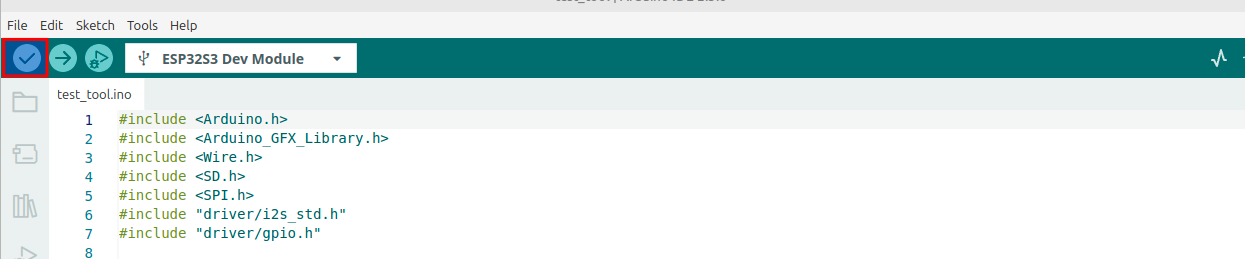
Nun kompiliert er
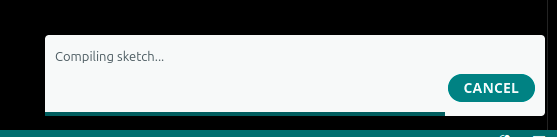
Wenn fertig steht in der Ausgabe wie viel Speicher benutzt wird.
Der Sketch verwendet 483199 Bytes (36%) des Programmspeicherplatzes. Das Maximum sind 1310720 Bytes.
Globale Variablen verwenden 22984 Bytes (7%) des dynamischen Speichers, 304696 Bytes für lokale Variablen verbleiben. Das Maximum sind 327680 Bytes.
Nun können wir das auf den ESP32 hochladen mit dem Pfeil nach recht Button
